How it works
QWTOOL is a cloud service that quality assures systematic energy optimization in buildings.
The method is based on energy auditing buildings at least 2 times per year to ensure that the building's existing installations for heat, cooling, and ventilation are used as energy efficiently as possible.
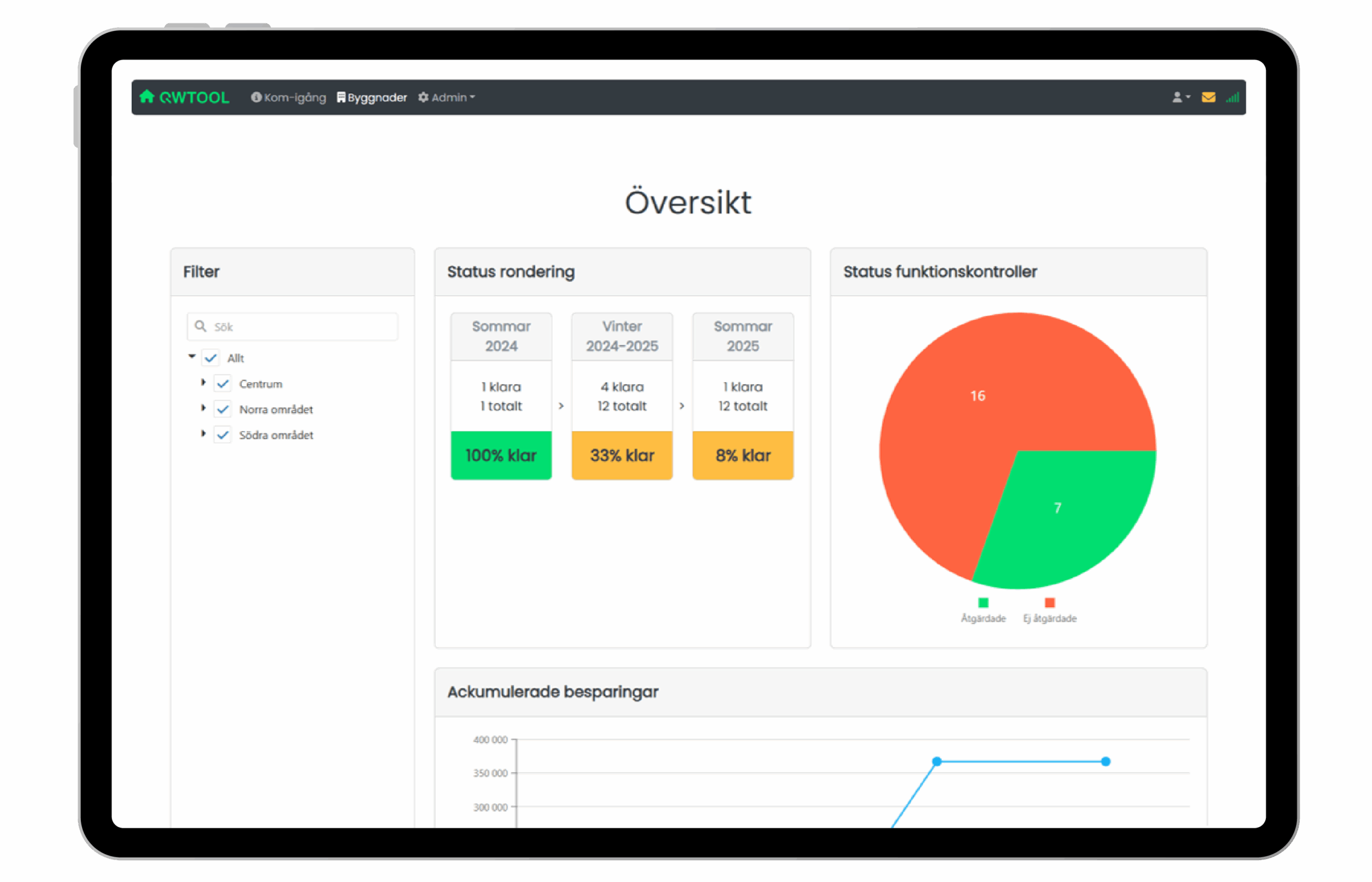
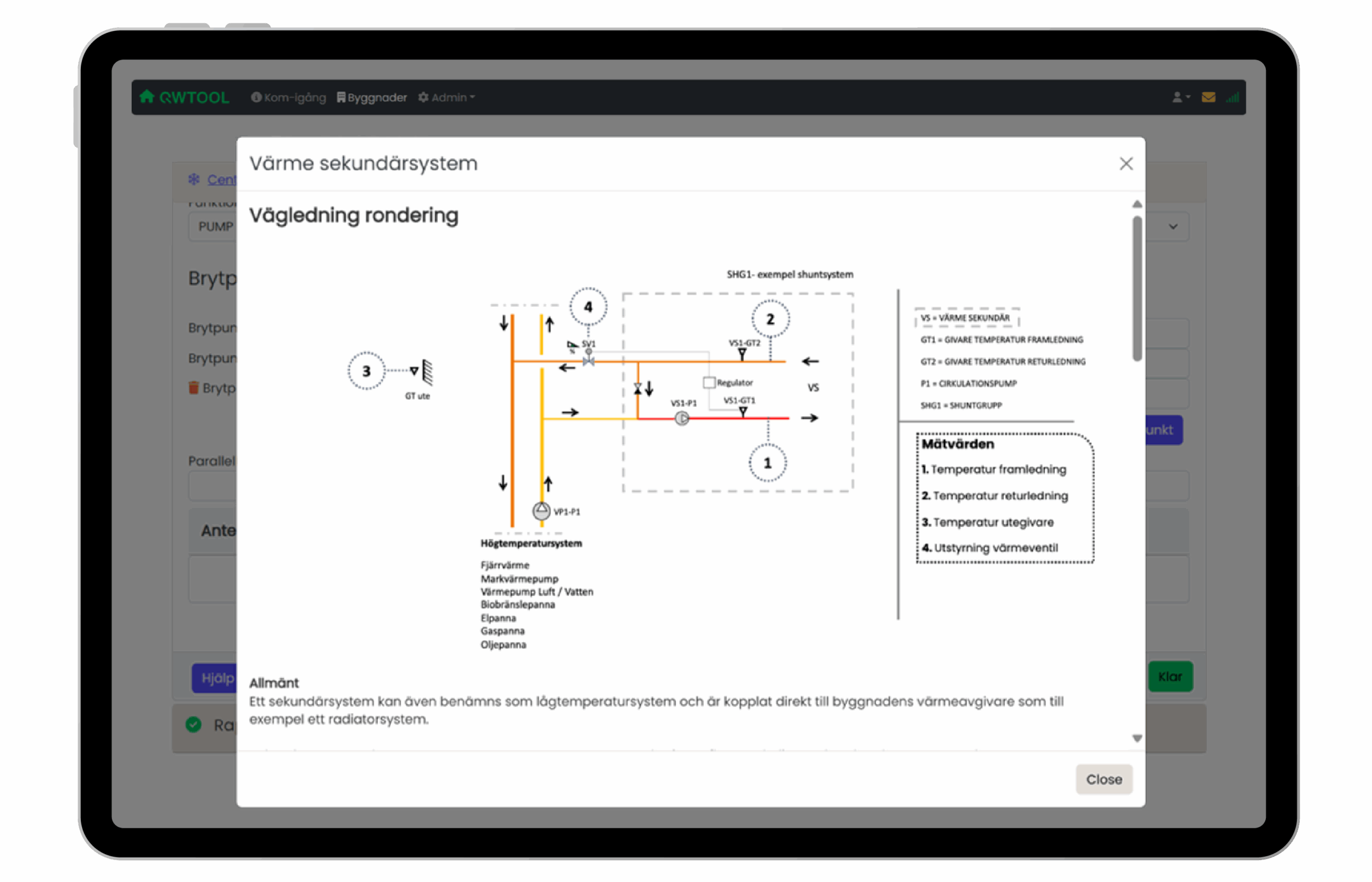
With QWTOOL, the user is guided by help functions through the different stages of the working method.
Temperatures in the facility are read or measured with handheld instruments and operating status is indicated.
The energy survey can be done on a mobile device, tablet, or laptop.
How it works
Step 1
Subscribe to QWTOOL subscription
Step 2
Register building data
Step 3
Energy savers
QWTOOL presents functional errors and suggestions for operational optimization
Step 4
Optimize setting values & fix functional errors
Step 5
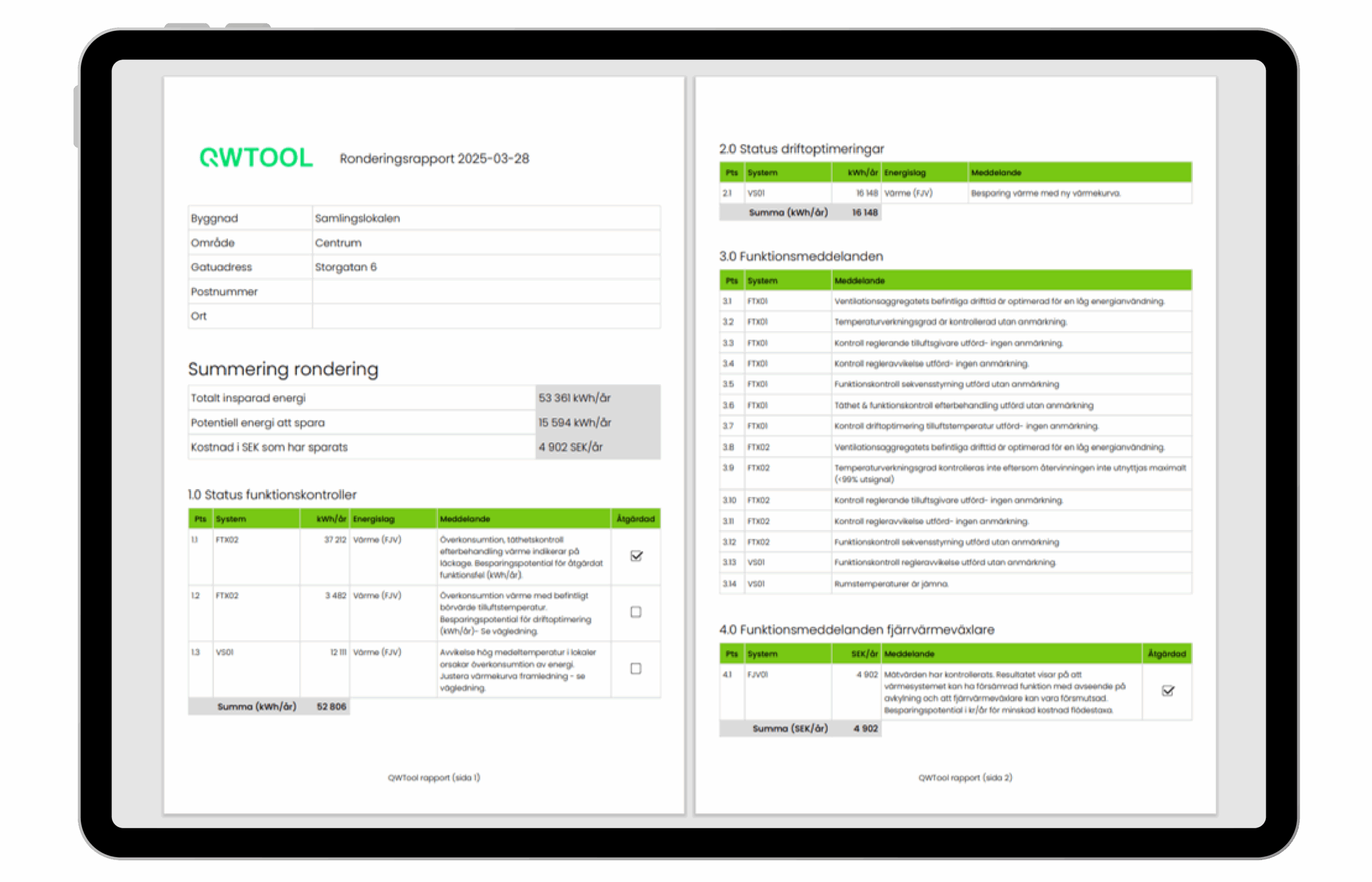
QWTOOL creates report

01
Subscribe to QWTOOL subscription
Create an account and select buildings for subscription

02
Register building data
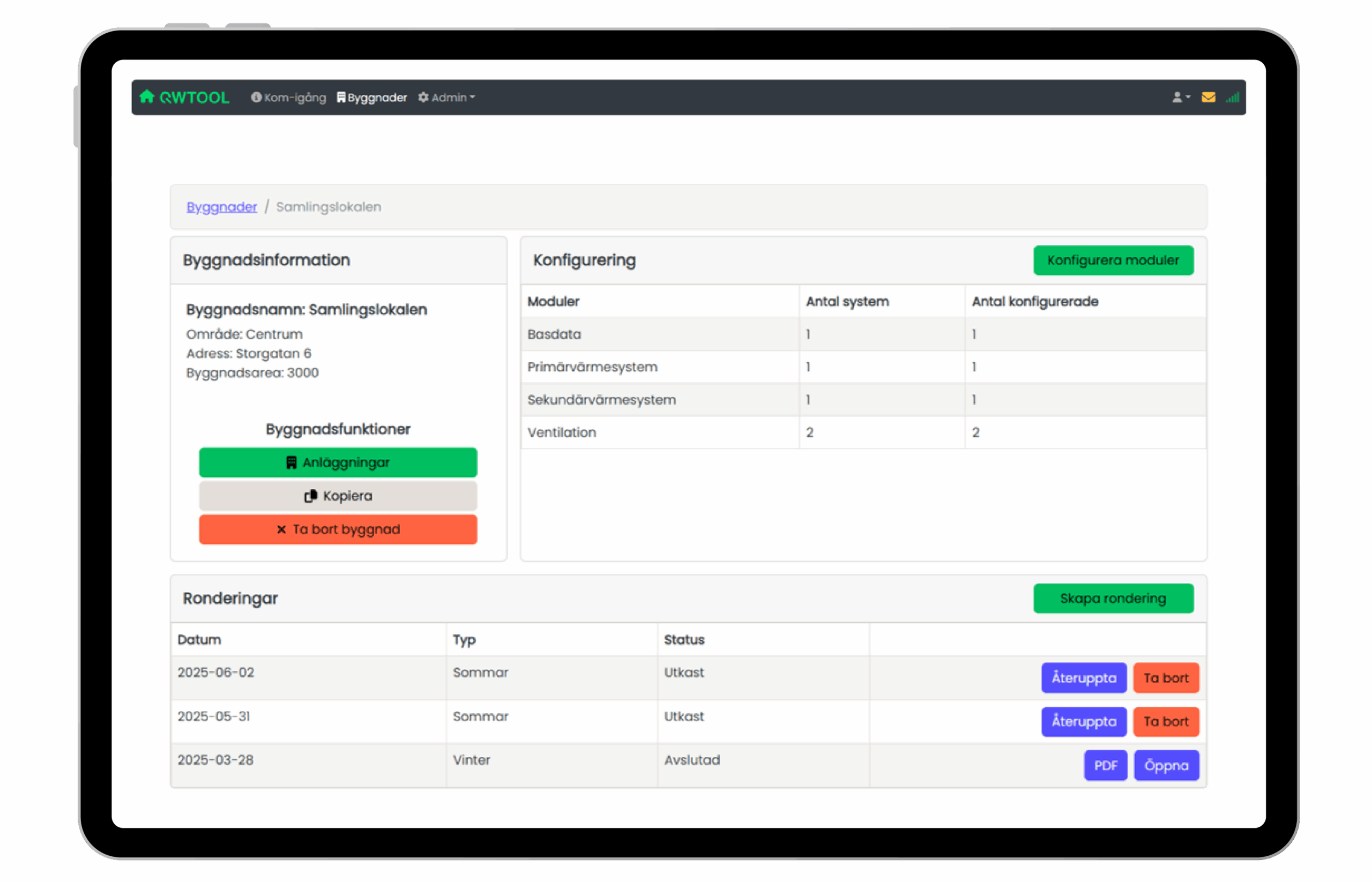
Before the first energy scan, configure QWTOOL with building data information. Each building gets a unique set.

03
Energy savers
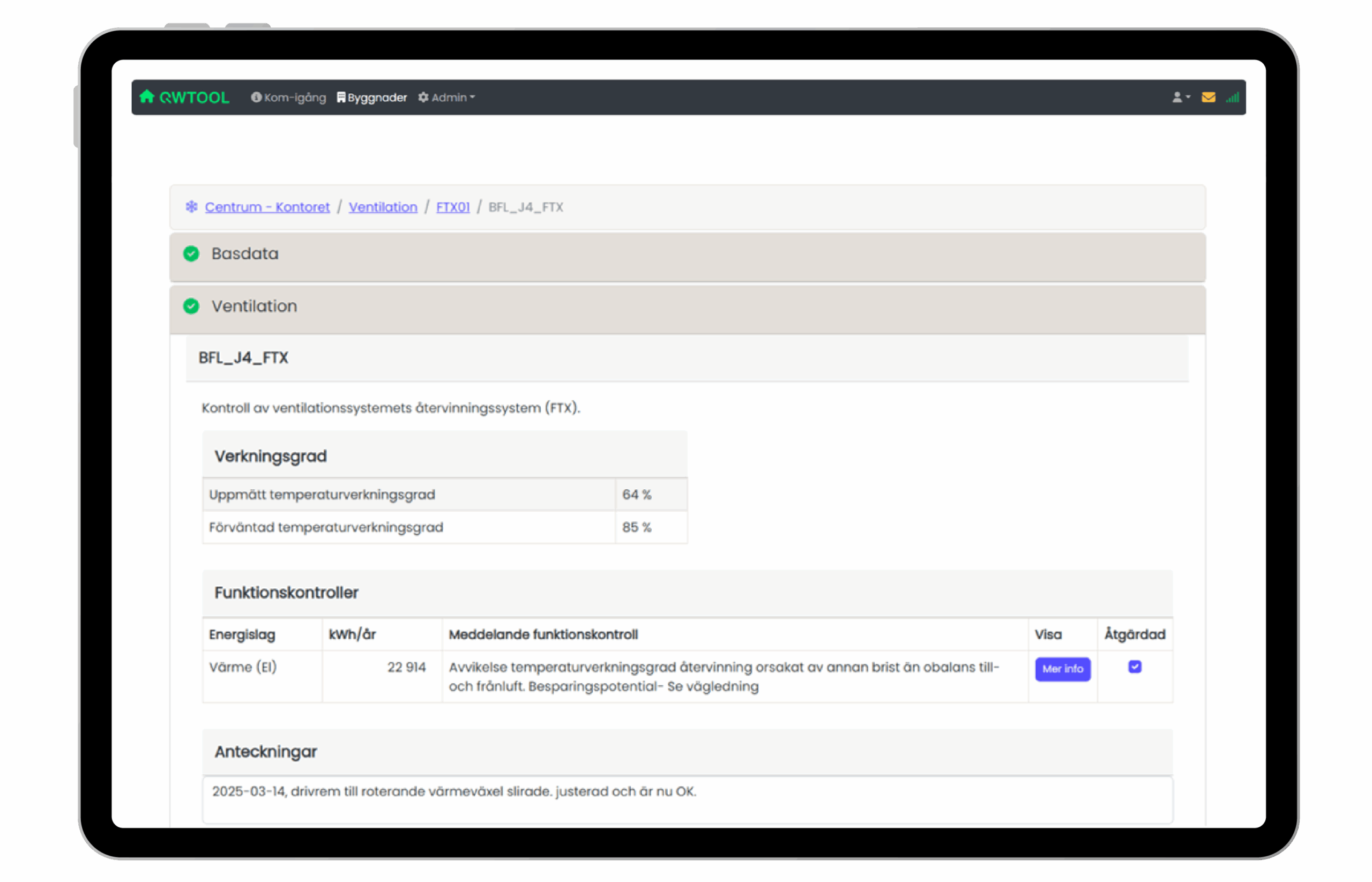
Rounds start with reading or measuring temperatures in the facility using handheld instruments. The operating status of the facility is indicated.

04
Optimize setting values & fix functional errors
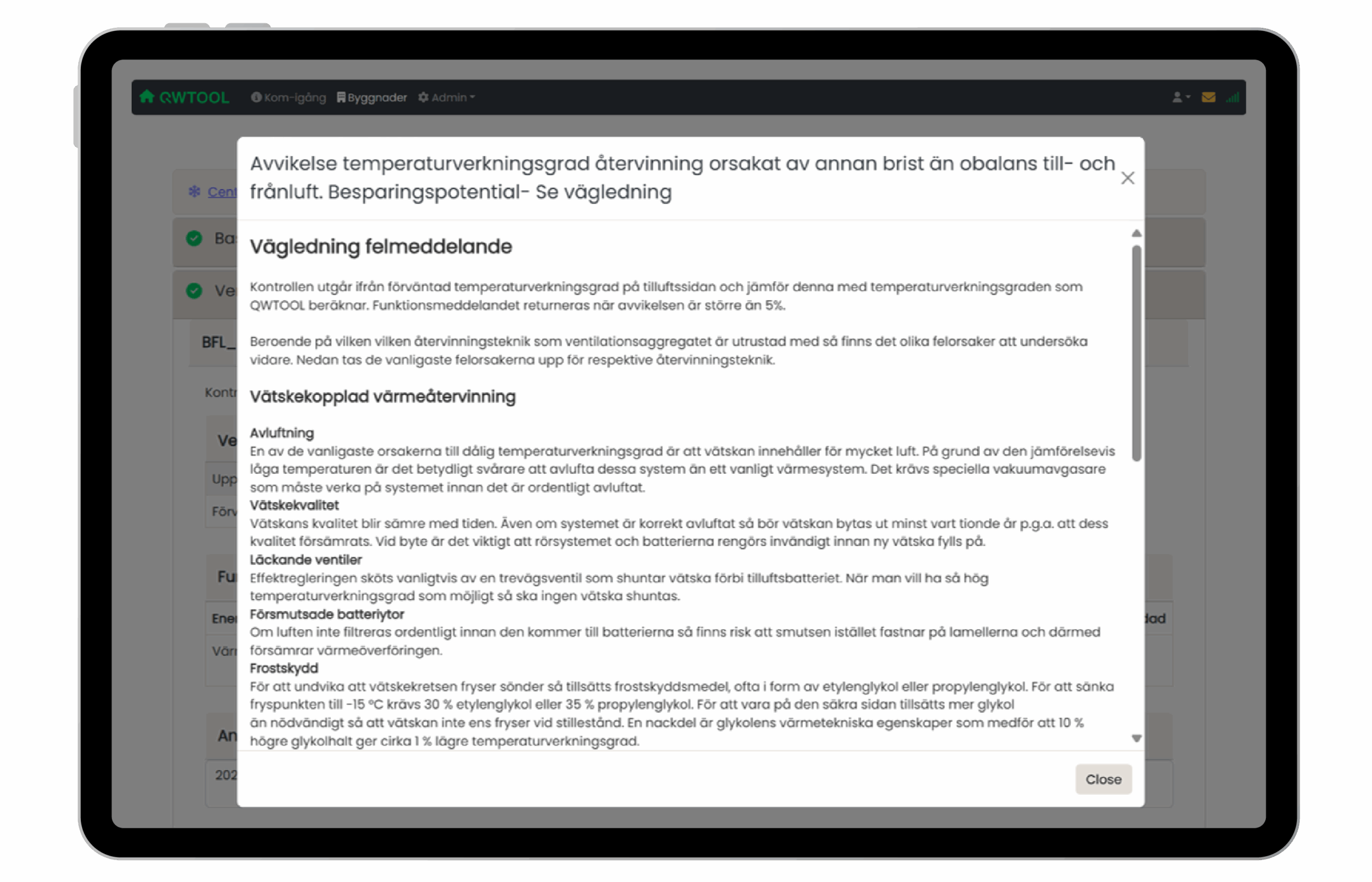
QWTOOL identifies and presents faults as well as optimization opportunities during the survey. Adjust settings and rectify detected faults. The potential for savings is calculated and displayed in kWh.

05
QWTOOL creates report
When the survey is complete, you receive a clear report that summarizes the building's status, detected deviations, and estimated energy-saving potential in kWh.
Calendar year
Energy survey

10%
Calculation example
Economic value
Medium-sized commercial building that reduces energy usage by 10% compared to the base year.
Price for subscription 1 medium-sized commercial building of 2,445 sqm
$243/month
Average energy cost for building
40,000 kr/month
Possible cost savings with the tool
4,034 SEK/month
Subscription cost is invoiced annually at 2,909 SEK
The subscription cost for QWTOOL corresponds to 6% of the savings earned.
Optimization suggestions
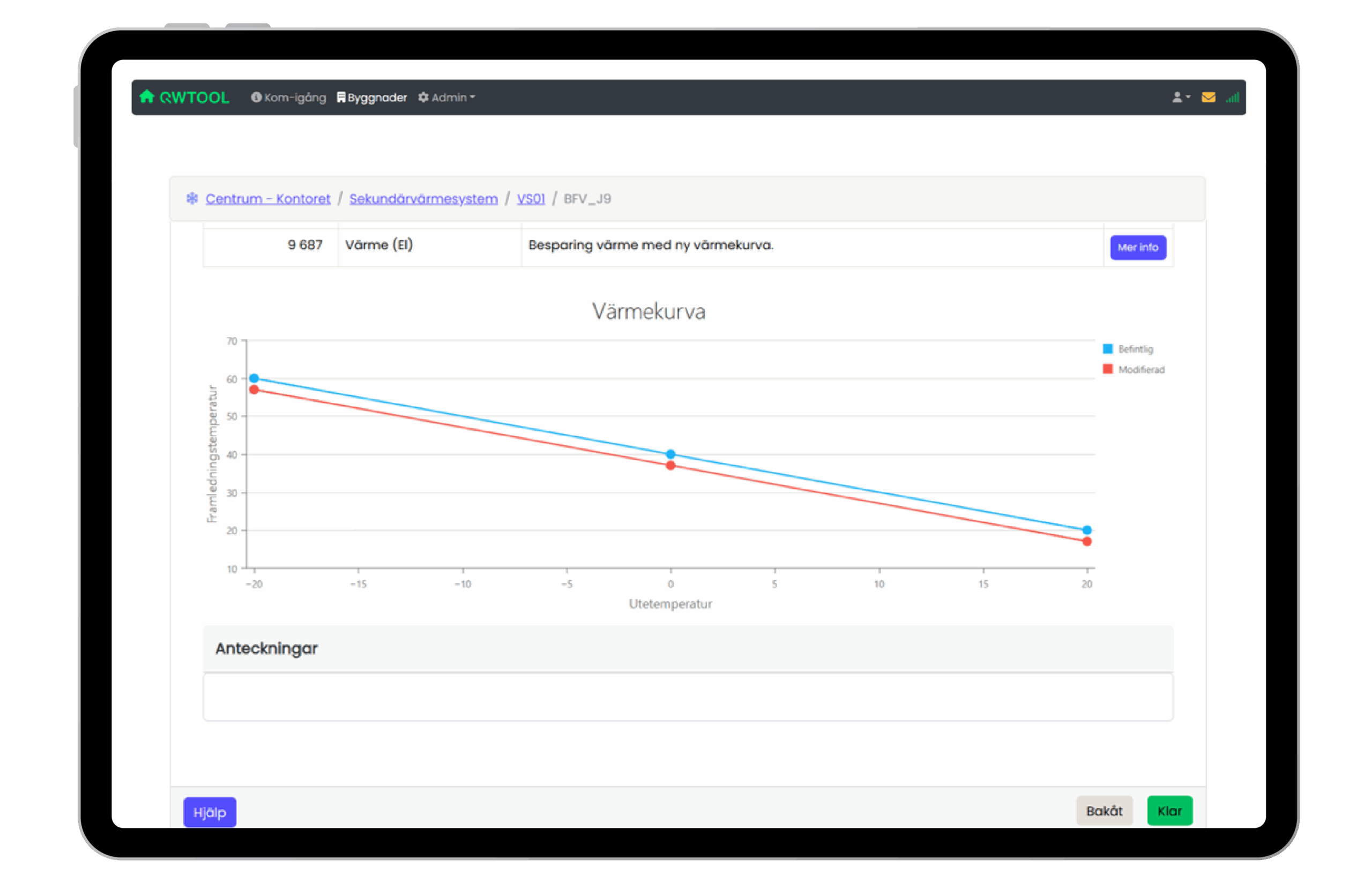
Optimization suggestions to reduce energy consumption and improve perceived indoor comfort are presented in QWTOOL as a function of the values entered by the user.
This part of the work involves optimizing operating settings in the building's control and regulation systems. For identified savings potential and performed optimizations, the energy saving (kWh) is quantified.
Function tester
Function controllers in QWTOOL present identified faults and shortcomings that cause unnecessary energy consumption.
This part of the work involves restoring and quality-assuring the building's optimal energy performance. For detected and rectified faults, the energy saving (KWh) is quantified.
Energy survey
Benefits of using QWTOOL
The systematic energy work is quality-assured by following a given work procedure
The support tool makes the working method easier to perform and thereby simpler to allocate resources for
The working method with QWTOOL is scalable
Sharing and documentation of data is ensured with storage in cloud function
Property management receives support for operations follow-up through clear reports that document the status of the facility and the results of systematic energy work
The work of prioritizing actions is simplified by the function messages being described in plain text along with quantified energy savings
Energy savings in the range of 5 – 20 % for electricity and heat are commonly achievable in a real estate portfolio.
The repayment period for the subscription fee is usually less than 2 months.
A result of systematic energy work is that the operating net increases - you get a better financial result and the value of the properties increases
The tool is intuitive and contains help features in the form of guiding text & images
Technical email support is available from QWTOOL's certified energy expert
Frequently Asked Questions (FAQ)
There is great confidence that the building's energy system will remain efficient by catching deviations in energy consumption through control and regulation systems. However, it is not common for buildings to have such sophisticated systems that they can handle that task.
Energy technology systems need to be controlled, these systems consist of many technical components that wear out and break down over time.
Experience also shows that there may be deficiencies in the technical systems that were not noticed during the installation phase. These malfunctions are missed due to inadequate inspection or that the inspection did not apply performance testing.
Control and regulation systems have many different setting options, these settings need to be reviewed regularly and adapted to the current operation and season.
- The most common ventilation systems such as FTX-FT-F-FX and S-systems.
- Liquid-borne heat systems such as secondary heat, primary heat district heating, heat pump.
- Direct-acting electric heating systems.
- Cooling system & cooling machine.
- Temperature deviations in heating and ventilation systems
- Density check of heating valves and cooling valves
- Performance measurement recycling system ventilation
- Operating hours ventilation unit & adaptation to needs
- Sequence control recovery – heat – cooling
- Supply air temperature setpoint
- Pump shut-off function & setting value
- Heat curve setting
- Temperature in premises
- Local space controls
- Coefficient of Performance for heat pumps (SPF - SCOP)
- District heating system's cooling function (QW value)
- Coefficient of performance of the refrigerating machine (SPF – SCOP)
Accepted calculation methods with actual measured values are used in QWTOOL to obtain quantified calculation results. Where actual data included in calculations is missing, the user can in some cases choose a standard value that QWTOOL suggests.
The user specifies the energy statistics for the building.
Where energy statistics information is missing, the user can choose default values.
Default values for energy consumption will be based on information about the building's geographical location, building area, year of construction, activities in the building, and type of heating system. Default values for energy consumption are retrieved from the Energy Agency.
In calculations where standard values are used, the risk increases that the quantified calculation result deviates from the actual outcome.
By quantified calculation results is meant in this context to describe with numbers a reasonable size of how large a functional error is - or how large the impact of an operational optimization is, the unit of size is expressed either in kilowatt hours (kWh) or in amounts (SEK).
The property's technical systems differ in their operating conditions depending on whether there is a winter or summer climate outside.
To ensure that the technical systems work energy-efficiently throughout the year, energy audits need to be performed during both the winter and summer seasons.
Features in QWTOOL are adapted based on whether you choose winter or summer routing.
Winter rounds can be performed when the building's heating system is activated.
This usually occurs at ≤15°C.
If the building's ventilation system is an FTX system with energy recovery, then the recovery should also be 100% loaded during the commissioning, at this operating point the after-heating battery starts to be activated. This most commonly occurs when the outdoor temperature is between +12 and -5°C or lower.
Summer rounds can be performed when the building's heating system is typically not active. If the building has any form of comfort cooling system, that system is activated. This most commonly occurs at ≥18°C.
*The FTX system is a ventilation system with mechanical supply and exhaust air where heat in the exhaust air is recovered to the supply air side.
Direct energy savings in the range of 5 – 20 % for electricity and heat are commonly realized in a
Property holdings where discovered functional faults are rectified and proposed operational optimizations are carried out. The level of energy savings is an empirical value from 10 years of work
with the working method in commercial and public premises.
With QWTOOL, it is possible to reduce a building's energy consumption down to the level that corresponds to the building's projected energy performance and maintain energy consumption at this optimal level.
If a building already has optimized energy usage, QWTOOL will not further reduce the building's energy performance, in those cases the energy saving will be 0%. On the other hand, it is possible to ensure that the optimal energy usage is maintained.
Buildings with more serious deficiencies in the technical systems can have savings potential exceeding 20%.
Reading of temperatures can be done with the plant's electronic or analog sensors if these are placed according to the schematic description specified in QWTOOL.
Where fixed sensors are missing or where fixed sensors have questionable measurement values, the measurement value is checked with a handheld instrument. Outdoor sensors should always be checked against handheld instruments.
Reading with handheld instruments can be done with contact sensors, IR thermometers or IR thermal cameras. For measuring air temperature in rooms, outdoors, in ventilation ducts and in ventilation units, it is recommended to use handheld instruments with wire sensors.
There are handheld instruments that can combine the different measurement methods available. An IR thermometer with a wire probe is a good combination for working with energy audits.
For measurement with an IR thermometer on shiny surfaces, it is recommended to use emission tape or matte masking tape at the measurement point since shiny surfaces provide incorrect measurement values.
Yes, it is possible to perform the energy survey. You can enter data into the energy survey and QWTOOL will return functional messages & calculation results.
Yes, click on Support and fill in your request for a personal demonstration.